What Students Learn
Introduction to Technology
The purpose of this course is to give students an introduction to the areas of technology and to introduce students to the design and problem-solving processes using manipulative skills cooperatively with others in team activities.
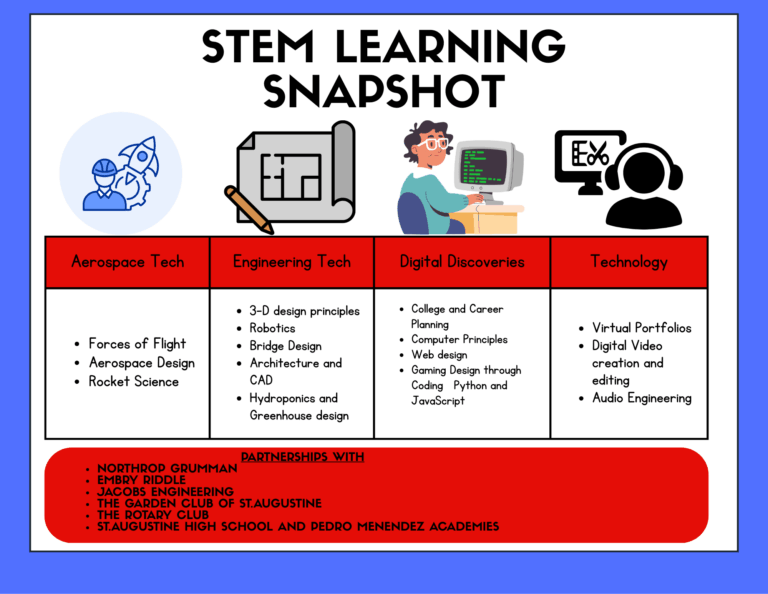
Exploration of Aerospace Technology
The purpose of this course is to give students an opportunity to explore the area of aerospace technology and its associated careers. Students will be given the opportunity to solve technological problems using a variety of tools, materials, processes and systems while gaining an understanding of the effects of aerospace technology on our everyday lives.
Exploration of Engineering Technology
The purpose of this program is to provide students with a foundation of knowledge and technically oriented experiences in the study of the applications of technology and its effect upon our lives and the choosing of an occupation. The content and activities will also include the study of safety, and leadership skills. This program focuses on transferable skills and stresses understanding and demonstration of the technological tools, machines, instruments, materials, processes and systems in business and industry.
Digital Discoveries
Digital Discoveries introduces students to computer science as a vehicle for problem-solving, communication, and personal expression. The course focuses on the visible aspects of computing and computer science. It encourages students to see where computer science exists around them and how they can engage with it as a tool for exploration and expression. It is also critical to diversify the technological workforce. Addressing inequities in computer science is critical to bringing it to all students. The tools and strategies in this course will help teachers understand and address well-known equity gaps within the field. All students can succeed in computer science when given the right support and opportunities, regardless of prior knowledge
In Grade 6 Digital Discoveries, instructional time will emphasize the following areas:
Active learning experiences are relevant to students’ lives and provide students with authentic choice. Students are encouraged to be curious, solve personally relevant problems and express themselves through creation. Learning is an inherently social activity, so the course is designed to interweave lessons with discussions, presentations, peer feedback, and shared reflections. As students proceed through the pathway, the structures increasingly shift responsibility to students to formulate their own questions, develop their own solutions, and critique their work.
In Grade 7 Digital Discoveries, instructional time will emphasize the following areas:
Active learning experiences are relevant to students’ lives, and provide students with authentic choices. Students are encouraged to be curious, solve personally relevant problems and express themselves through creation. Learning is an inherently social activity, so the course is designed to interweave lessons with discussions, presentations, peer feedback, and shared reflections. As students proceed through the pathway, the structures increasingly shift responsibility to students to formulate their own questions, develop their own solutions, and critique their work.
In Grade 8 Digital Discoveries, instructional time will emphasize the following areas:
Active learning experiences, relevant to students’ lives, and provide students with authentic choices. Students are encouraged to be curious, solve personally relevant problems, and express themselves through creation. Learning is inherently social, so the course is designed to interweave lessons with discussions, presentations, peer feedback, and shared reflections. As students proceed through the pathway, the structures increasingly shift responsibility to students to formulate their own questions, develop their own solutions, and critique their work.